

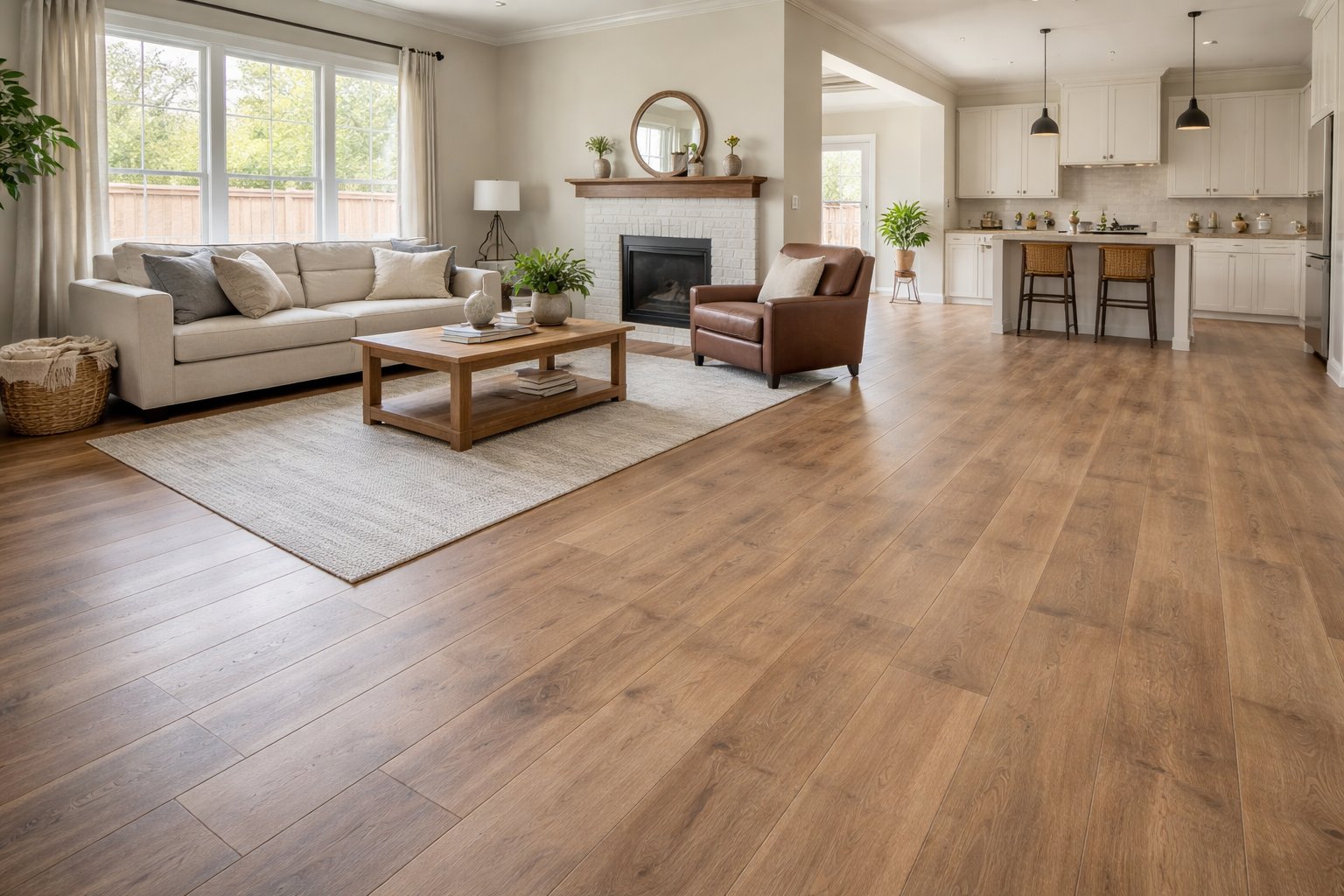
Across Oklahoma, slab-on-grade construction remains the dominant foundation type for residential homes. From Oklahoma City to Tulsa and surrounding communities, concrete slabs offer durability and cost efficiency—but they also place unique demands on flooring systems. Temperature swings, seasonal moisture movement, and minimal subfloor forgiveness mean that not every flooring product performs equally well over concrete.
Choosing the right flooring system for slab-on-grade construction isn’t about trends alone. Performance, stability, and long-term reliability matter just as much as appearance. Understanding which flooring types consistently succeed in Oklahoma slab homes helps avoid costly repairs, moisture issues, and premature replacement.
What makes slab-on-grade foundations different
Concrete slabs behave differently than raised subfloors. Moisture vapor transmission, alkalinity, and temperature fluctuation all affect how flooring materials expand, contract, and bond. Even well-cured slabs can release moisture long after construction is complete, especially during humid Oklahoma summers.
Because slab foundations lack airflow beneath the floor, moisture has fewer escape paths. Flooring systems installed directly on concrete must either tolerate this environment or include installation methods that mitigate it. Products designed with dimensional stability and moisture resistance tend to outperform traditional materials that rely on airflow or flexible subfloors.
Luxury vinyl flooring as a slab-friendly solution
Luxury vinyl flooring consistently ranks among the best-performing options for slab-on-grade homes. Its rigid construction, waterproof core options, and floating installation systems make it especially compatible with concrete substrates.
Many modern vinyl products include built-in underlayment layers that help smooth minor slab imperfections while reducing sound transmission. More importantly, vinyl’s resistance to moisture vapor makes it a dependable choice when slab conditions vary seasonally.
Floating systems allow natural expansion and contraction without stressing adhesives or fasteners, which is critical in slab homes. That’s why many Oklahoma builders and homeowners rely on luxury vinyl flooring when durability, moisture tolerance, and visual appeal all need to work together.
Porcelain and ceramic tile for long-term durability
Tile remains one of the most structurally compatible flooring systems for slab foundations. When installed with proper surface preparation and movement accommodation, porcelain and ceramic tile bond exceptionally well to concrete.
Porcelain tile, in particular, offers low water absorption and high density, making it well suited for kitchens, entryways, and living areas in slab homes. Crack isolation membranes and correctly placed expansion joints help protect tile installations from slab movement over time.
For homeowners prioritizing longevity and low maintenance, tile flooring continues to perform exceptionally well over concrete when installed by experienced professionals who understand slab behavior.
Engineered hardwood designed for slab environments
Solid hardwood traditionally struggles over concrete slabs, but engineered hardwood changes the equation. Its layered construction improves dimensional stability and reduces the risk of warping or cupping caused by moisture fluctuations.
In slab-on-grade homes, engineered hardwood performs best when installed as a floating floor or with moisture-tolerant adhesives. Proper acclimation and slab moisture testing remain critical, but engineered options provide a realistic wood look without the risks associated with solid planks on concrete.
Laminate flooring with moisture-conscious construction
Modern laminate flooring has evolved significantly and now performs far better over slab foundations than earlier generations. Waterproof and water-resistant laminate cores protect against surface moisture while maintaining visual consistency.
Floating laminate systems allow movement without stressing the slab interface, making them suitable for open floor plans commonly found in Oklahoma homes. Underlayment selection plays a key role in smoothing minor slab imperfections and supporting long-term performance.
The role of proper slab preparation
Even the best flooring system can fail if slab preparation is overlooked. Moisture testing, surface leveling, crack treatment, and vapor mitigation are essential steps before installation begins.
Concrete slabs must meet manufacturer specifications for moisture content and flatness. Skipping these steps often leads to adhesive failure, surface irregularities, or visible movement later. Flooring systems that succeed on slab foundations do so because preparation and product selection work together—not because of material alone.
Choosing systems that align with Oklahoma conditions
Oklahoma’s climate places real-world stress on flooring systems installed over concrete slabs. Products that tolerate moisture, allow movement, and rely on stable construction consistently outperform rigid or moisture-sensitive materials.
Selecting flooring with slab performance in mind protects both investment and comfort, especially in homes where seasonal changes are unavoidable.
Talk with our flooring experts about slab-on-grade solutions
Mill Creek Carpet has supported Oklahoma builders and homeowners for decades with flooring systems that perform reliably over slab foundations. Our flooring experts help evaluate slab conditions, material options, and installation methods to ensure long-term success. Visit one of our showrooms or reach out through our contact us page to start the conversation.


